
Changing minds
Where did my world view come from?

(Hi, This is David. I’m experimenting with Voiceover in case it’s more convenient. I’m very slow at normal speed. So if you’d like to try it, I recommend x1.25 or even 1.5.)
Harold Wilson’s speech about the White Heat of the Technological Revolution (in 1963) was the biggest influence on my early life choices, along with the Biafran famine of the late 1960s. I wasn’t a politically-minded youth, obviously, because I came away from school with the notion that the world’s problems had technical solutions. So it was science and technology for me, none of that airy-fairy stuff that would never lead to a proper job.

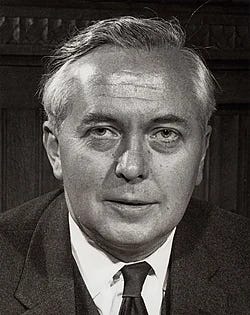
I don’t remember saying any of this out loud or even reflecting on it. I’d inhaled a couple of data-points and started to imagine I knew something about the world. This seems to expose a shortcoming in my education. It was a posh school too. It took another 15 years before I realised I didn’t know anything much at all and started to be astonished by my ignorance. The learning I value most now came along by accident, rather than from any formal education. I wonder if I’m unusual in this respect.
The gap which concerns me most is history. How can I make sense of my present if I don’t know how I got here?
Moments of awakening
Exhibit 1: My Dad’s English Literature textbook. (English Literature: Its history and its significance for the life of the English-speaking world by William J Long. 1909.) History tells us what happened, I read there. Literature tells us how people were thinking and feeling about it at the time.
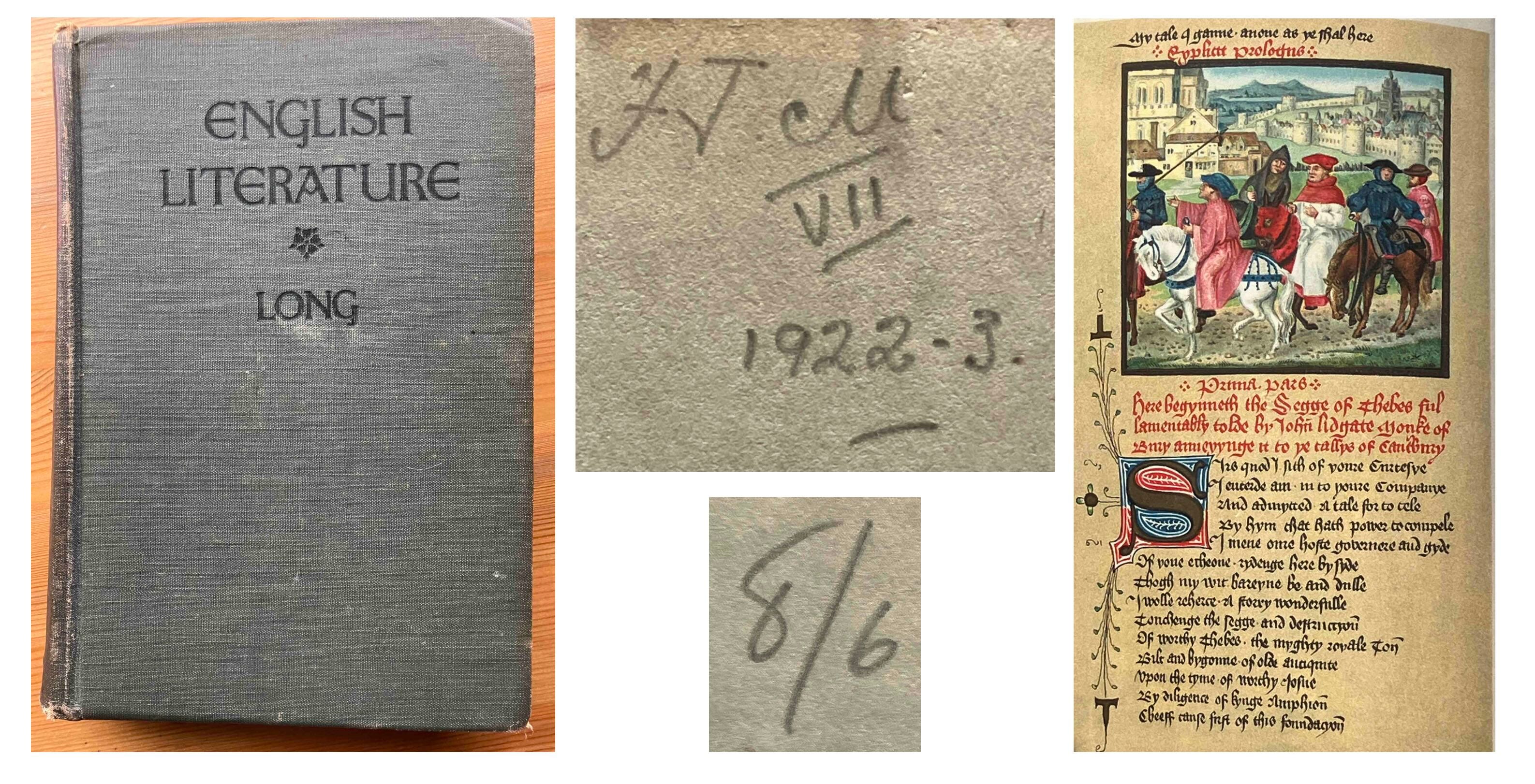
This is my Dad’s handwriting from 1922, age 16. He died in 1989, age 83. Seems he paid 8/6 for the book – eight shillings and sixpence, £0.425 in UK pounds today, nearly 50p. Must’ve been a fortune then. Look at the quality of that colour print … in 1922! Available now free to download at Wikimedia Commons,.
Four years a prisoner of war in Japan, he found some resilience and survived with his physical and mental health intact. No PTSD for our family. I’ve always appreciated my good fortune, having such a kind and loving family but only recently recognised this element of ‘near-miss’.
When I asked him the meaning of a word he obviously knew, he’d never tell me, reaching for the dictionary instead. I found it annoying at the time but I’ve inherited the habit. I don’t think he was even trying to teach me anything. He just wanted to make sure that the meaning we were looking for was correct.
At my school we never had an English Literature textbook. We had Macbeth, Great Expectations and so on but there was no common thread. It took the Reverend Long, a few decades later, to explain to me why I’d been reading these books.
Exhibit 2: My son’s history homework (Circa 2000). There’s no actual exhibit, just my memory of a short page of notes with some questions at the end, a couple of hundred words maybe. (Call this homework? I thought.)
The topics were the Agricultural and Industrial Revolutions and the First World War. As I was inwardly sneering (I hope it was inward) I noticed that these three topics created one story. (Of course they did! That’s what history is about.) I’m blushing now. Surely it wasn’t the first time such a thought had occurred to me? Probably not. Can’t have been. I was nearly 50.
False starts
I had started trying to improve my knowledge of history long before this. I’d had Dickens’s, A Child’s History of England from the library but found it patronising and heavy with Victorian moralising. More recently, with the internet, Coursera arrived and I enjoyed three substantial history courses online.
The first considered the Silk Road with a premise that history began when subsistence societies started to produce more than they needed. So they could start to trade. The second covered the period from Columbus’s ‘discovery’ of the Americas to the present day. But after rinsing hours of reading and listening through my brain, little remains apart from these slight, unreliable impressions.
Breakthrough!
The third course was the History of Humankind presented by Yuval Noah Harari and it opened a rich seam for me. It was later published as his bestselling book ‘Sapiens’ and I found it satisfying; a ‘systems’ view of history offering a context for what is happening in the world now. It gave me a foundation for my Donkey Hopeful reflections (Topic 1: We’ve used up all the space).
So this keeps my interest, not the winners and losers at war but the driving forces behind prosperity and conflict. It’s why my ears pricked up when Amol Rajan described demogrraphy as the ‘secret engine of history’, as he introduced Paul Morland on his ‘Radical!’ podcast. This episode did change my mind. When the topic of demography comes up now I no longer imagine I know what’s coming and am more inclined to listen.
While searching I also found Patrick Wyman’s ‘Tides of History’ podcast in which he starts every episode with a story based on authentic historical research. Weaving fictional threads together Patrick brings to life a vivid impression of a community or a society and the forces shaping its comings and goings. Hurrah! That’s what I’m looking for.
So far so good
I’m still a long way from a satisfying level of knowledge but I have some traction now. In a recent episode, (19 March 2026, Tides of History S2, E172, Popular History and Academic History), Patrick speaks about the work of academic and popular historians. For the former, scholarly discipline is all important and skilled communicators may even be regarded with suspicion. So writers of popular history (such as himself), whose goal is to engage a less academic public, must stay credible by keeping up to date with current research.
He doesn’t hide his own scorn for those who fall short of his demanding standard. He mentions ‘Empire of the Summer Moon’ by S C Gwynne about the Comanche. As a story he found it “borderline riveting” but as history, “it’s somewhere between disappointing and hot garbage”. Then he went on, “The worst offenders are the so-called big-thinking books, like Yuval Noah Harari’s ‘Sapiens’, where the author makes a claim to authority but then clearly demonstrates they haven’t actually done much reading on the topics they’re supposed to know well.”
Oh no! My two new best friends aren’t friends with each other! Now what? I’ll just have to use my own judgment. It’s disconcerting at first but feels good to listen to knowledgeable people with different opinions and be left with the responsibility to make up my own mind.
You write:
'The topics were the Agricultural and Industrial Revolutions and the First World War. ... I noticed that these three topics created one story. (Of course they did! That’s what history is about.)'
a) what is the 'one story' that you noticed and, b) why is that what history is about?